Elementary students writing at their desks
For K-12 districts

Know every student.
Reach every student.

Faro measures what each child understands, captures how they think, and shows teachers what could be taught next — for the students in their room.

Book a demo
Scroll

One record of what each student knows

Every step reads it and writes back to it. Then the model learns: it ranks what measurably moved students on that skill across every classroom, and writes with that first next time.

How Compass is built

  • Built on the research behind computer-adaptive assessmentFaro applies the published science of adaptive testing — item calibration, ability estimation, stopping rules — and builds it with modern technology. Items are field-tested, calibrated, and reviewed on a monthly cycle.
  • A fraction of the seat timeDesigned to reach the precision of the hour-long diagnostics with far fewer items, so the period goes back to teaching.
  • Beginning, middle and end of yearWindows a teacher can open for her own class. Growth is measured on the same scale every time.
  • Results hand off; they don't sitAreas of focus flow straight into tutoring, practice, and the next lesson.
Compass · Grade 4 math · FractionsSample check-in
Grade 3Early 4Grade 4Above
1of 5 items
4
Overall placementOn grade level
Proficient
Domain levels
Fractions and equivalence—
Place value and operationsGrade 4
Measurement and geometryAbove
Can do
    Areas of focus, in order

      Sample items for illustration. A real Compass check-in asks 12–30 items and reports across every domain in the subject.
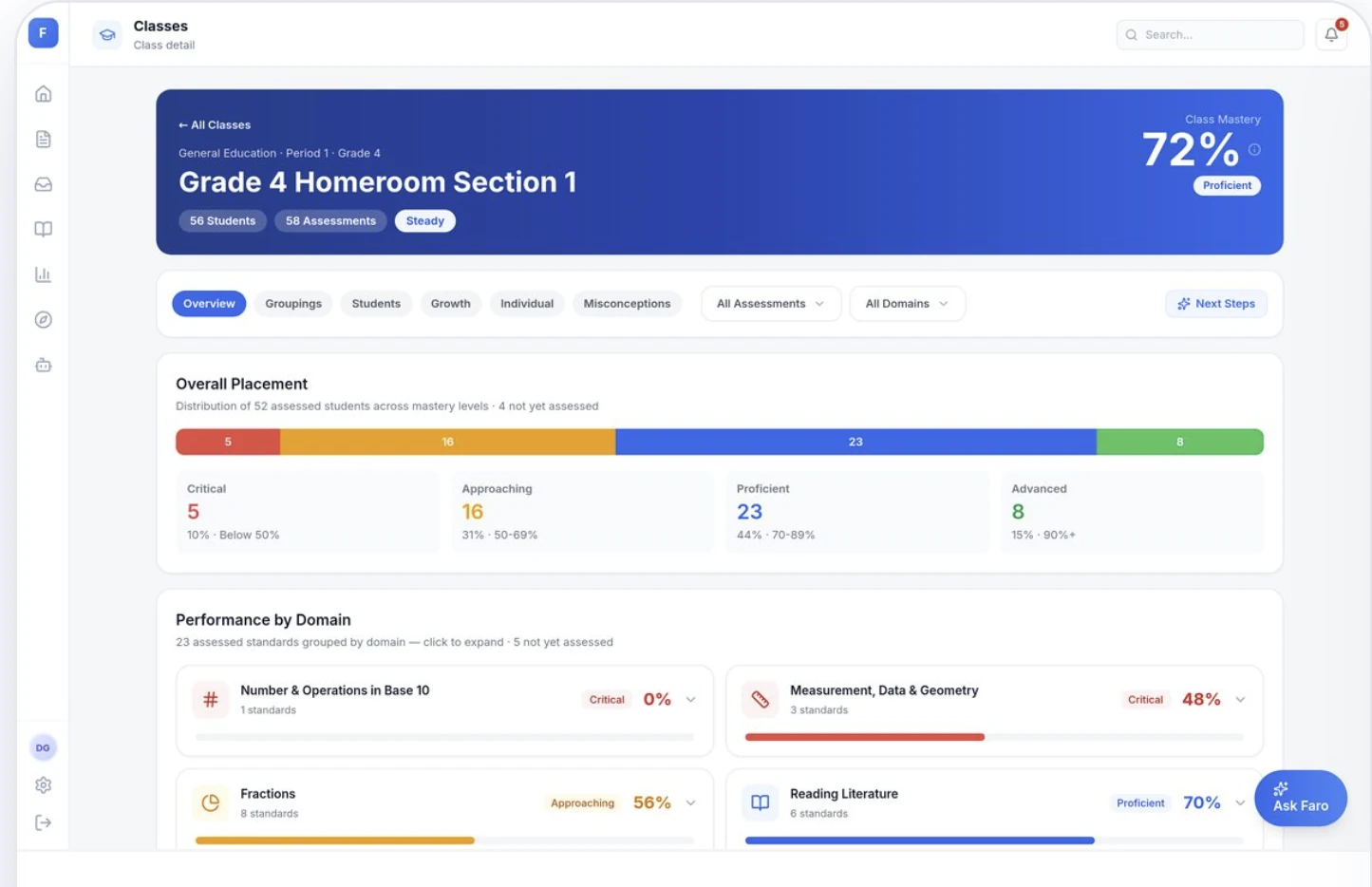
      Class detail after a Compass check-in: placement distribution across mastery levels and performance by domain
      What the teacher sees after the check-in: placement first, then every domain, on one screen.
      An elementary classroom: a teacher at the front, students at their desks with hands raised
      Faro Brain

      Capture the work. Hear the thinking. Find the misconception.

      Faro Brain captures each student's work and asks them to explain how they got their answer. It reconciles the response with the reasoning, names the misconception, expands on it for the student, and aggregates it across the class — so the teacher knows which idea to reteach tomorrow, and to whom.

      Kenji · during the testitem 4
      34× 2620468272 should be 680

      Kenji explains: "I did 6 times 34 and got 204. Then 2 times 34 is 68. Then I added them."

      • 1 · CaptureThe student's work, as they did it: a photo of the page, pencil strokes on a tablet with replay, typed work, or a scanned stack from the doc camera.
      • 2 · ArticulateThe student explains how they formulated the answer, in their own words or voice.
      • 3 · ReconcileFaro compares the response to the reasoning and names the specific misconception. If it can't read the work with confidence, it says so and hands it to the teacher. It never guesses.
      • 4 · ExpandThe student gets a micro-lesson on that exact idea, then a short probe weeks later to confirm it held.
      • 5 · AggregateMisconceptions roll up to the class: which students share which idea, ranked, with a lesson kit for each. That is tomorrow's small group.
      • Private by constructionThe misconception library describes ideas, not children. Raw work stays district-scoped, encrypted, and expires in ninety days.
      Room 12 · Tomorrow · Two-digit multiplication24 students
      1 small group3 quick check-ins15 on track
      6
      Forget the place-value shift on the second rowMultiply by the tens digit as if it were ones, then add. Confirmed in six students' work.
      3
      Drop the carry when a product passes tenCorrect setup, lose the regrouped ten.
      2
      Worth your eyesFaro couldn't read the work with confidence, so it didn't guess.
      Machine learning

      Drafted for this student. Not pulled from a library.

      Other platforms "personalize" by placing a child into a catalog of pre-built lessons. Faro's machine learning reads the student's record — what they understand, how they read, what supports they need, what's fading — and drafts the lesson, the practice, and the family note for that child, for the teacher to review. Then it learns which instruction moved students, and offers that first.
      Their personalizationDiego scores into "Fractions, Lesson 12." So does every other child who scored the same. The lesson doesn't know he reads two grades up or that Spanish is spoken at home.
      Faro's machine learningEvery item is written from Diego's record — his reading level, his language supports, the exact idea that's fading — and gets sharper as the model learns what worked for students like him.
      • 1 · QueryWhat each student understands right now: concepts, skills, grade-level expectations, reading level, language supports, accommodations, what's fading, and where your district expects them to be.
      • 2 · DraftAssessment, lesson, small groups, leveled practice, an individual path, and a family note — drafted from that one lookup for the teacher to review. Never a lesson number.
      • 3 · LearnThe model ranks what measurably moved students on that skill across every classroom, and offers it first next time.
      Faro · Generate24 students on roster
      Room 12 · Grade 4 · Comparing unlike denominatorsLooks up the class first. Drafts second.
      Press Run to watch Faro look up the class before it drafts a word.
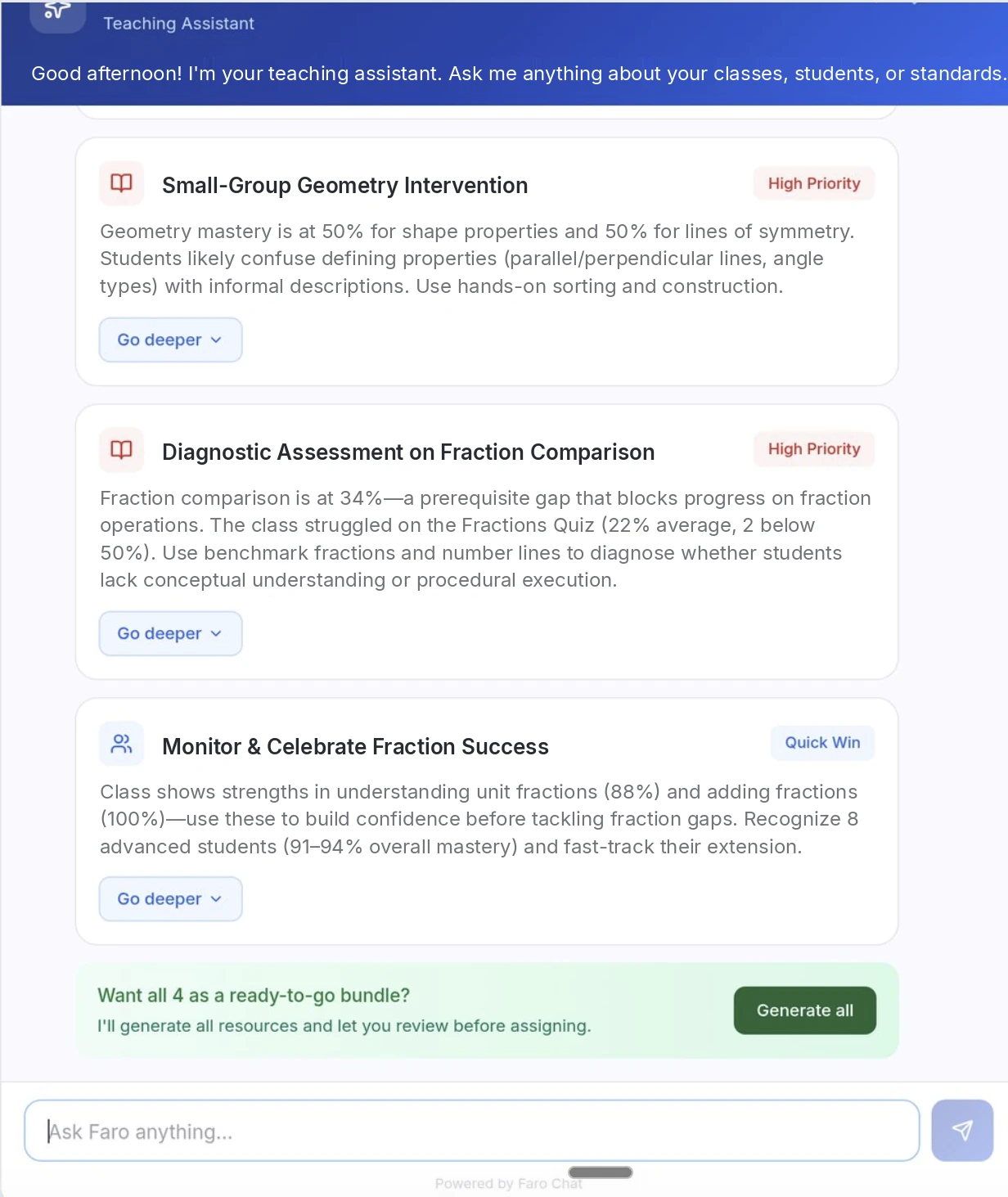
      Faro drafts prioritized next steps for a class, each with Go deeper and a Generate all option
      The drafts, ranked. The teacher opens what she wants and decides what is taught.
      A teacher speaking with a class
      Instruction

      Tomorrow's lesson, drafted for tomorrow's class

      Lesson plans, small groups, leveled practice, exit tickets, and 89 more content types — each drafted from the class record, checked against twelve quality criteria, readability measured, with supports for English learners and students with special needs built in. The teacher decides what is taught next and approves what ships.

      What Faro drafts

      • Every kind of assessmentDiagnostic, screener, formative, exit ticket, practice set, unit exam, benchmark, performance task, progress monitoring.
      • Every kind of instructional documentLesson plans, small-group plans, leveled texts, choice boards, rubrics, anchor charts and more — 89 content types across nine categories.
      • Held to twelve quality criteriaIncluding "a ten-year veteran uses it without rewriting." Readability is measured and shown on every piece. Drafts until the teacher accepts them.
      • English learners get the real thingCognate connections and home-language scaffolds, not a watered-down copy.
      • Students with special needs are on the recordAccommodations and modifications carried on the student record shape what is drafted: extended time, read-aloud, reduced load, larger print, simplified language, chunked directions, scaffolds and sentence frames. Every piece can be produced in an accommodated version, and the teacher sees which supports were applied.
      • Next steps on everythingEvery document ends with what to do tomorrow, by name. Constructed responses are scored by the teacher.
      Small-group plan · Comparing fractions with unlike denominatorsDraft
      Grade 4Readability 3.8Group of 6Spanish cognates on
      Watch forThree students in this group still compare by numerator alone. Open with 2/3 vs 2/6 on the fraction strips before any symbols.
      Drafted for Room 12 · until the teacher acceptsNext steps →
      Students

      Practice that knows why they got it wrong

      When Compass or Faro Brain finds an area of focus, the student gets a path: the concept first, then worked examples, then practice that adapts. Every attempt writes back to the record the teacher sees. No live model speaks to a child.

      How a student is coached

      • Concept firstWhen Compass or Faro Brain finds an area of focus, the student gets a short video on the idea, then worked examples, then practice.
      • Practice that writes backEvery attempt updates the same record the teacher sees, so re-teaching starts from today's work, not the last test.
      • Age-appropriate by designWhat a child sees is reviewed material. No live model speaks to a child.
      • Nothing hidden from the adult in the roomA teacher review queue for anything a student got stuck on.
      Tutoring · Comparing fractionsReviewed path
      Which is bigger, 3/4 or 5/8? Show me how you're thinking about it first.
      5/8 because 5 and 8 are bigger numbers
      Good instinct to look at the numbers. Let's picture the same pizza cut two ways. Watch this, then try it again.
      ▶
      Comparing fractions with pictures2 min · concept first, then practice
      An adult helps a child with schoolwork at a table
      Families

      What your child can do. What to try this week.

      A note in the family's language: what the child can do, what they're working on, and one thing to try at home. No scores. No codes. Written from the same record the teacher sees.

      What a family receives

      • Plain wordsWhat the child can do and what they're working on. Never a scale score, never a standard code.
      • One thing to try this weekA concrete activity for the kitchen table, written from the child's actual area of focus.
      • In the family's languageWritten, not translated after the fact.
      • A family portalProgress, notes, and how to help at home — the same record the teacher sees, at family scope.
      Family note · Diego · Grade 4 · Room 12Español

      Diego is reading above grade level and is confident with place value. Right now he's working on comparing fractions that have different denominators. This week, try cutting one sandwich into halves and another into quarters and ask which piece is bigger — and why.

      EspañolEnglish
      Reporting

      One record. Student to district.

      Mastery rolls up from the child to the classroom, the campus, and the district on one scale, against your state's expectations. A principal and a teacher are looking at the same number. Four portals, one truth.
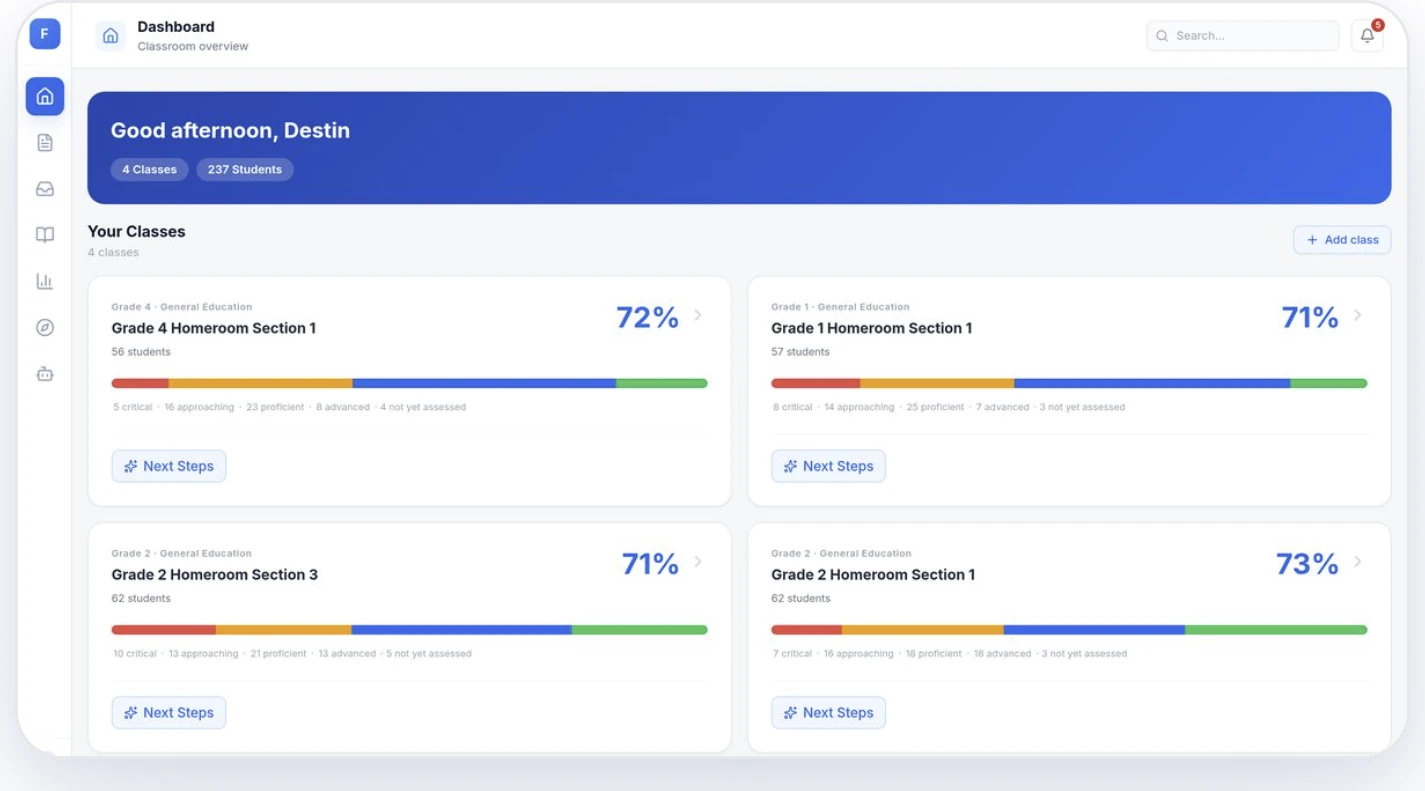
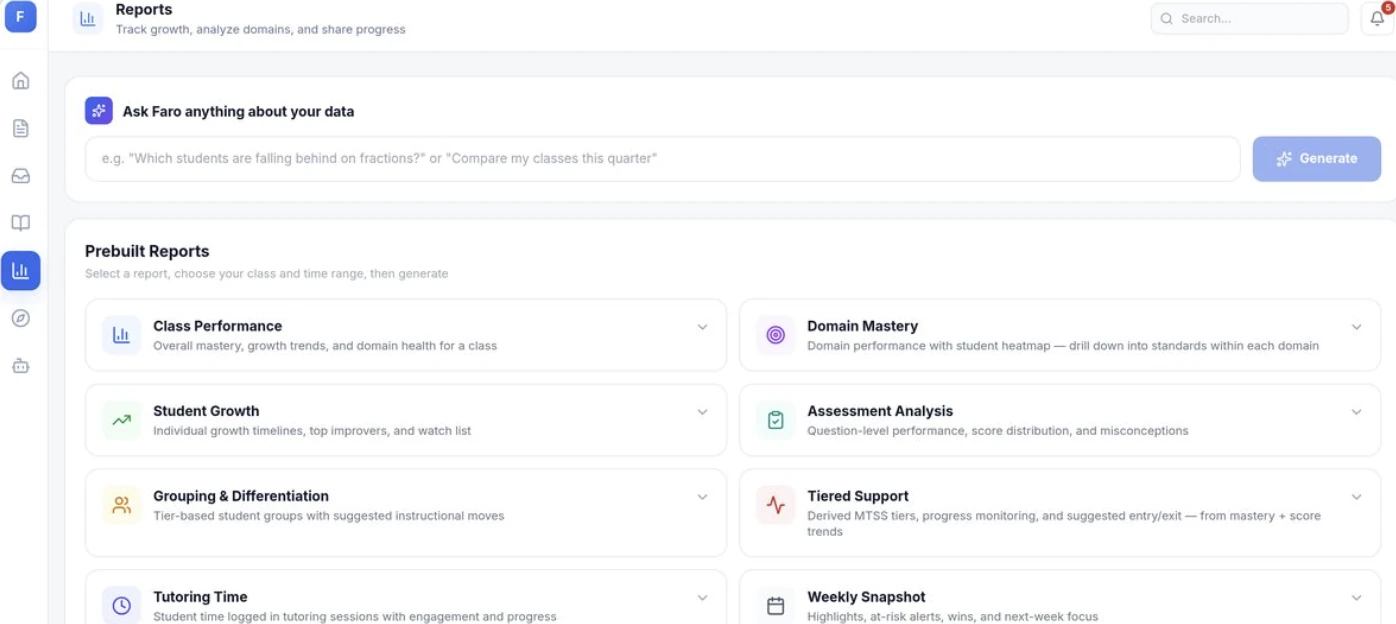
      Four portals, one Faro

      • TeachersAssess, group, generate, review, grade. The home page shows who needs what today.
      • StudentsAssignments, their own path, tutoring, and progress they can understand.
      • FamiliesPlain-language notes, progress, and how to help at home.
      • AdministratorsRostering, district reporting, cut scores, and every campus on one scale.
      • Ask Faro, everywhereOne panel away in every portal. It answers from the record and already knows what you're looking at.
      Teacher home: four classes, each with a mastery bar and a Next Steps button
      A teacher’s home page. Four classes, 237 students, who needs what today.
      Reports: ask Faro anything about your data, plus eight prebuilt reports
      Ask Faro in plain language, or pick a prebuilt report. Same record either way.
      A school building and its front lawn
      Why "Faro"

      Faro means lighthouse

      A lighthouse doesn't sail the ship. It shows you the way.

      Faro never takes the wheel from a teacher. It shows what each child knows, points at what's next, and gets quieter as the learning steadies.

      Privacy and fit

      Built for the district office

      • FERPA by designDistrict-scoped data, ninety-day retention on generated work, no student identifiers in links or logs.
      • COPPA consent gateStudents under thirteen are gated behind district-managed consent before anything is collected.
      • Rostering you already haveOneRoster 1.1 import with preview-before-commit. Clever and ClassLink sync.
      • Machine learning you can inspectModel-agnostic by design. Student data is never used to train a public model. Every generated piece is stored, attributable, and reviewable.
      • Your state's expectations, in your teachers' wordsEvery district is configured to its own framework. Standards show up as the skill, never as a code.
      • Nothing fake, everAn empty state stays honest. Faro never fills a gap with a placeholder number. Results from founding districts will appear here when they're true.
      Book a demo

      See your own students in it

      Bring a roster and a subject. In thirty minutes: a Compass check-in, a piece of student work captured and reconciled, a lesson drafted for that room, and the report your board would see. Pricing is per student, licensed to the district; we cover it on the call.

      Thanks — we'll reach out within one school day

      No student data is needed to book. Prefer email? [email protected]